SUBLOR is a research project funded by the European Union under the Horizon Europe
programme's Marie Skłodowska-Curie Actions Postdoctoral Fellowships, grant agreement No.
101282277.
The project
The SUBLOR project is devoted to sub-Lorentzian geometry, the non-holonomic analogue of
Lorentzian geometry and the Lorentzian counterpart of sub-Riemannian geometry.
A sub-Lorentzian space is a
manifold \( M \) together with a family of admissible directions \( \mathcal{D} \subseteq \mathrm{T}(M) \), a
Lorentzian
inner product \( \langle \cdot, \cdot \rangle \) on those directions, and a choice of time orientation
in \( \mathcal{D} \).
Typically the number of independent directions available is smaller than the dimension of
\( M \), so motion is constrained: not every tangent direction in \( \mathrm{T}_x(M) \) is available.
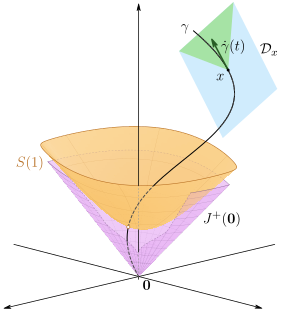
A curve \( \gamma \) is called horizontal when its velocity stays inside \( \mathcal{D} \). It is
causal if
\( \langle \dot\gamma(t), \dot\gamma(t)\rangle_{\gamma(t)} \le 0 \), chronological if
\( \langle \dot\gamma(t), \dot\gamma(t)\rangle_{\gamma(t)} < 0 \), and it is future-directed when
it points consistently along the chosen time orientation. The length of a causal curve is given by the usual
Lorentzian formula
\[
L(\gamma) := \int_0^T
\sqrt{-\langle \dot\gamma(t), \dot\gamma(t) \rangle_{\gamma(t)}} \, \mathrm{d}t.
\]
The time-separation function \( \tau(x,y) \) is obtained by taking the supremum of these lengths among all
horizontal future-directed causal curves from \( x \) to \( y \):
\[
\tau(x, y) := \sup\left\{
L(\gamma) \;\middle|\;
\gamma \text{ is horizontal, future-directed causal, from } x \text{ to } y
\right\}.
\]
The associated causal and chronological futures and pasts, denoted by \( J^\pm(x) \) and \( I^\pm(x) \), are
defined as in Lorentzian geometry, but using only horizontal causal or timelike curves.
This setup models constrained spacetimes where motion is limited to a subbundle of directions, analogous to
sub-Riemannian geometry but in a Lorentzian setting. The figure above illustrates how a causal curve
\( \gamma \) must remain tangent to \( \mathcal{D} \), with its velocity \( \dot{\gamma}(t) \) lying in the
admissible
future-directed cone. Every Lorentzian manifold is a sub-Lorentzian
manifold by taking \( \mathcal{D} = \mathrm{T}(M) \), so sub-Lorentzian geometry
generalises
Lorentzian geometry.
While recent developments have extended Lorentzian geometry to the non-smooth setting and sub-Riemannian geometry
has become a well-established and active area of research, sub-Lorentzian geometry remains largely
underexplored.
The project SUBLOR, mentored by Michael Kunzinger, will address this gap by:
Integrating sub-Lorentzian structures into the framework of Lorentzian length spaces and metric spacetimes.
Characterising the infinitesimal geometry of sub-Lorentzian manifolds via timelike metric tangents.
Developing curvature notions adapted to sub-Lorentzian geometry, including optimal-transport-based
conditions and Hamiltonian curvature.
If you would like to hear more about SUBLOR, discuss related research, explore possible
collaborations, or get involved, do get in touch!
Our new preprint, Ollivier-Ricci
curvature for causal sets, addresses a long-standing problem in causal-set geometry:
how can Ricci curvature be detected using only causal order and counting? Combining Lorentzian optimal
transport with the order-theoretic structure of causal sets, we introduce a new Ollivier-Ricci
curvature based on causal diamonds. The construction successfully recovers timelike Ricci curvature
on smooth Lorentzian manifolds, while numerical experiments illustrate how it works on discrete
spacetimes.
The first preprint of the SUBLOR research project is out: Constant mean curvature surfaces in
the sub-Lorentzian Heisenberg group. We study and classify smooth
Lorentz-symmetric constant mean curvature hypersurfaces in the sub-Lorentzian Heisenberg group. Among
them, we identify a candidate solution to the Lorentzian isoperimetric problem. This is comparable to
the role of the Pansu bubble in the sub-Riemannian isoperimetric conjecture.
I took part in the Lange Nacht der
Forschung, Austria's largest public event dedicated to science, research, and innovation,
offering
free activities for all ages.
Our station featured games,
demonstrations, and visual material on Einstein's theory of special and general relativity, and
curvature. A personal highlight was Hyperbolica, a
non-Euclidean adventure game in which players explore bizarre curved worlds filled with
puzzles.
Today marks the launch of the new MSCA research project SUBLOR on the foundations of
sub-Lorentzian geometry!